
July 21, 2026
Clinical Trial Feasibility in Neurology: From Protocol to Patient List
"Neurodiscovery AI has been instrumental in transforming real-world neurology data into actionable insights that improve patient care and sustain private practice. Their commitment to neurologists—ensuring both business success and innovation in drug discovery—makes them an invaluable partner to NeuroNet and the entire field of community neurology."
Joseph V. Fritz PhDPartner,
How Atomizing I/E Criteria Makes Real Cohort Intelligence Possible
Every clinical trial begins with the same problem. A protocol arrives carrying a precise set of inclusion and exclusion criteria each one clinically reasoned, carefully worded. And then, almost immediately, turning that protocol into an actual patient list becomes informal. Coordinators fall back on manual chart review, opening records one by one and applying criteria through interpretation. The same criterion gets read differently across sites, across coordinators, across runs.
That inconsistency is a clinical trial feasibility problem before it's anything else. Around 80% of clinical trials experience enrollment delays, and fragmented, inconsistent patient identification is one of the most persistent contributors. The gap isn't a data problem, it's a structural one. The protocol has never had a reliable, computable bridge to the patient record.
This is the problem NeuroDiscovery AI's Cohort Builder was designed to solve: a clinical trial site feasibility patient database with a structured, intelligent way to interrogate real patient records not a replacement for the clinical coordinator, but a computable bridge from protocol to patient list.
What Atomizing I/E Criteria Means
Atomizing inclusion/exclusion criteria means breaking a protocol's eligibility language into its smallest individually checkable components one fact, one data source, one logic rule at a time instead of treating a criterion as a single block of text a human has to interpret. Where clinical trial feasibility assessments have traditionally relied on a coordinator's manual read of a chart, atomization gives each fact its own defined, auditable path to structured data: EHR fields, clinical notes, radiology reports. In doing so, it directly strengthens site feasibility assessment criteria transforming patient population estimates, recruitment potential, and inclusion/exclusion workability from coordinator judgment calls into structured, reproducible, data-driven outputs.
Why It Matters
Clinical research runs on eligibility criteria. But those criteria are written in medical language, while patient identification runs on EHR records, clinical notes, and radiology reports. Nobody built the bridge between them.
The downstream consequences are real. Enrollment timelines slip. Cohort quality drifts. Sponsors have limited visibility into how patient lists were built at the site level. And when a study gets challenged by a payer, a regulator, or a scientific reviewer the answer to "how did you identify these patients?" is often a shrug.
A criterion like "patients on an approved disease-modifying therapy with no relapse in the past 90 days" can be screened and interpreted differently by different people. That's a structural gap the industry has largely accepted as inevitable.
Common Challenges with Site Feasibility Assessment Criteria
Clinical trial site feasibility assessment criteria in practice, faces three persistent challenges:
-
Manual chart review is cognitively demanding, difficult to standardize, and highly susceptible to variation the same criterion can be read differently depending on who's screening and when.
-
Feasibility assessments for HEOR and medical affairs teams typically mean a data request, an analyst queue, and a week or more of waiting for a number that may or may not be reproducible.
-
Most cohort-building work isn't versioned, so sponsors and CROs have no consistent way to defend how a patient list was constructed if a study is challenged later.
Current Industry Approach
Most sites still resolve eligibility criteria through manual chart abstraction or basic keyword search against structured fields workable for simple, single-field criteria, but it breaks down on anything compound or clinically nuanced, like "aged 65+, no relapse in 90 days, excluding trial participants." Feasibility counts are typically produced by a data or biostatistics team running a one-off query, not a repeatable, auditable pipeline that a coordinator or sponsor can inspect directly.
How NeuroDiscovery AI Solves It
The Cohort Builder starts with a deceptively simple interface: describe what you're looking for in plain English.
"Donanemab patients with Alzheimer's disease, aged 65+, United States only, exclude clinical trial participants, since FDA approval."
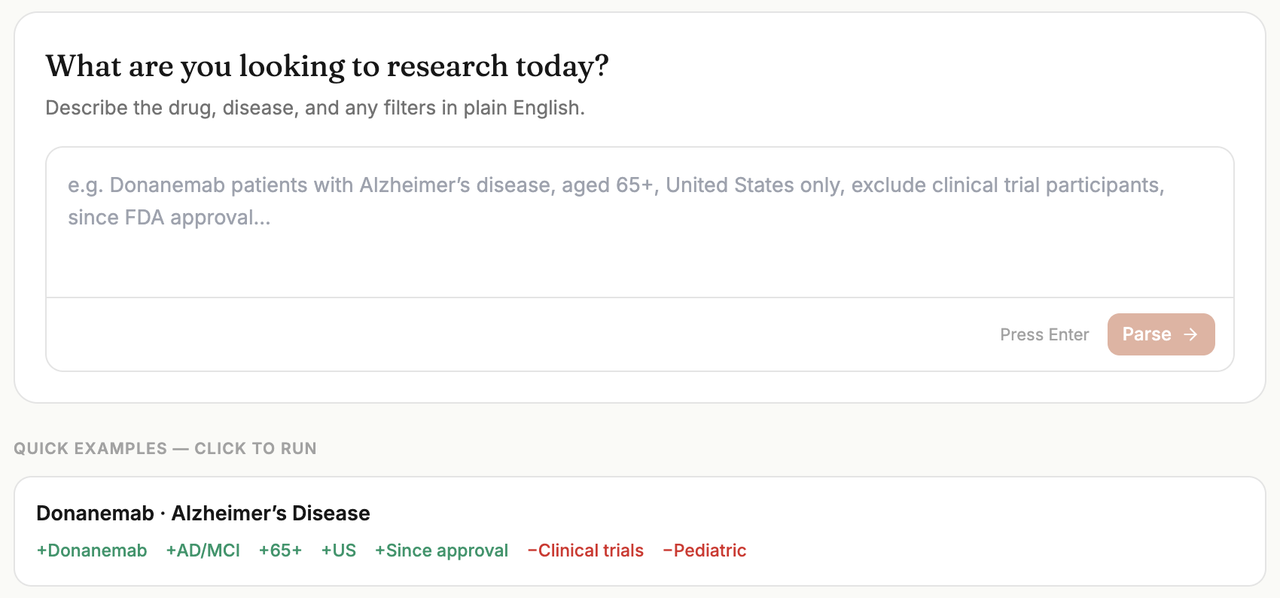
Fig. 1 — A plain-English query entered into the Cohort Builder interface.
Within seconds, the system parses that sentence into structured, labeled criteria Drug, Disease, Demographics, Geography, Timeframe. If anything is ambiguous or undefined, it catches it before execution and asks targeted clarifying questions, presented with recommended defaults so expert users move fast and less experienced users don't get stuck.
What makes this different from a search tool is what happens underneath.
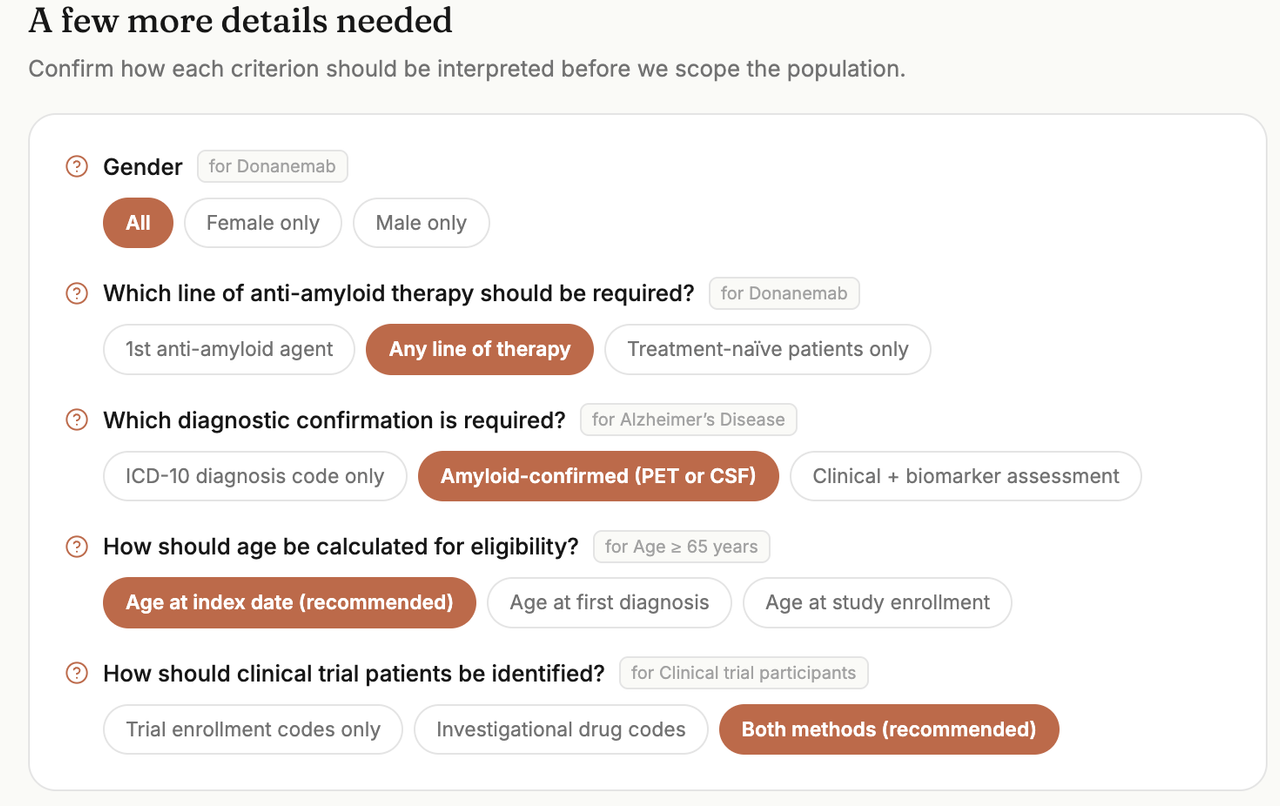
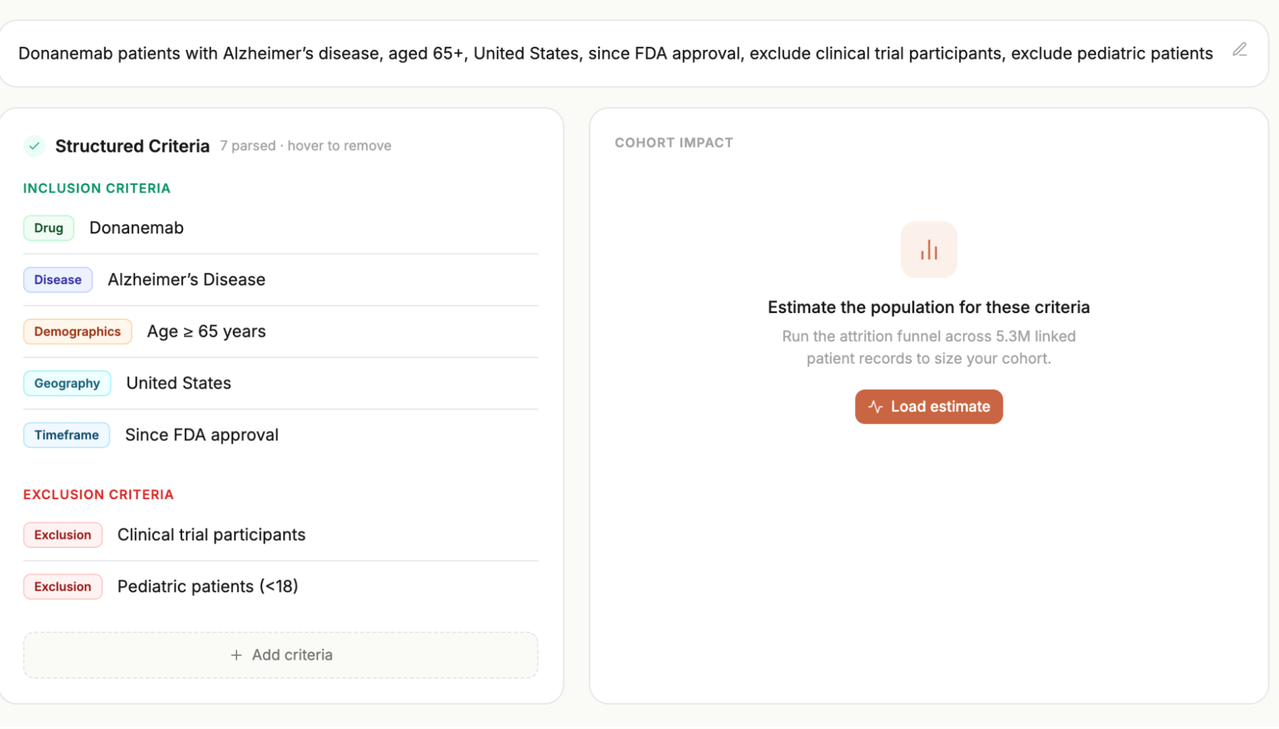
The DIT workflow: how a sentence becomes a patient list
Every criterion goes through a structured pipeline before a single patient is counted.
First, it's atomized and broken into its smallest individually checkable components. The Donanemab query above doesn't run as a single search. It becomes six discrete, individually checkable facts:
-
Drug exposure confirmed (Donanemab)
-
Alzheimer's diagnosis present
-
Age at index ≥ 65
-
Geography scoped to the United States
-
Timeframe anchored to FDA approval date
-
Clinical trial participants excluded
Each fact is tagged with its logic present or absent and its data source, before a single record is touched.
Second, each atom is classified and expanded using a two-stage AI process: a classification model assigns each atom to its clinical category: Diagnosis, Medication, Lab, Radiology, Demographic guided by system prompts that define precisely what belongs where. A second, critic model then reviews and validates that classification, correcting it where needed before anything proceeds. This isn't a static data dictionary it's a dynamic, self-checking classification layer that gets the routing right before search runs.
Donanemab maps to J-code J0175 and NDC 72811-0001. Alzheimer's disease maps to the full G30 family G30.0 (early onset), G30.1 (late onset), G30.8 (other), and G30.9 (unspecified). Age becomes current age ≥ 65, evaluated at the time of the cohort run. It isn't keyword search it's structured medical vocabulary applied systematically, in the same language the underlying data was recorded in.
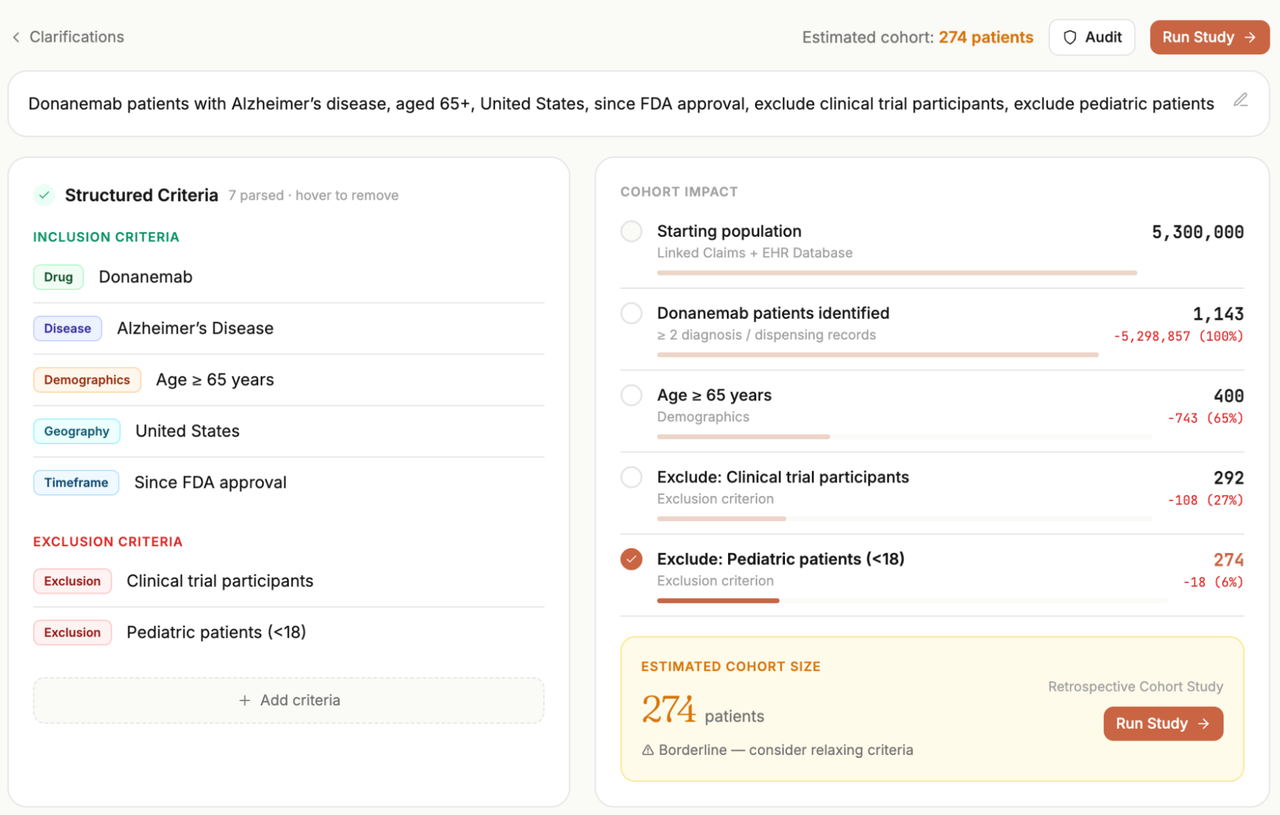
Third, each atom gets an evidence strategy. Simple structured criteria are evaluated deterministically, with no AI inference involved. In this example, every criterion resolves against structured fields the drug record, the diagnosis code, the demographic field, the enrollment flag and the system assembles the results into a step-by-step attrition waterfall:
-
Starting population: 5.3 million records
-
After Donanemab exposure confirmed: 1,143
-
After age filter (≥ 65): 400
-
After excluding clinical trial participants: 292, the final eligible cohort
Every drop is visible, every criterion is named, every exclusion is counted. The system counts. It doesn't guess.
Finally, the results are assembled into an attrition waterfall every criterion applied in sequence, with patient counts at each step. That waterfall isn't just an output. It's a complete audit trail.
Disclaimer: The patient counts and workflow outputs referenced in this edition are sourced from a prototype of the NeuroDiscovery AI Cohort Builder. Figures are illustrative and will vary based on study design, data source configuration, and eligibility criteria.
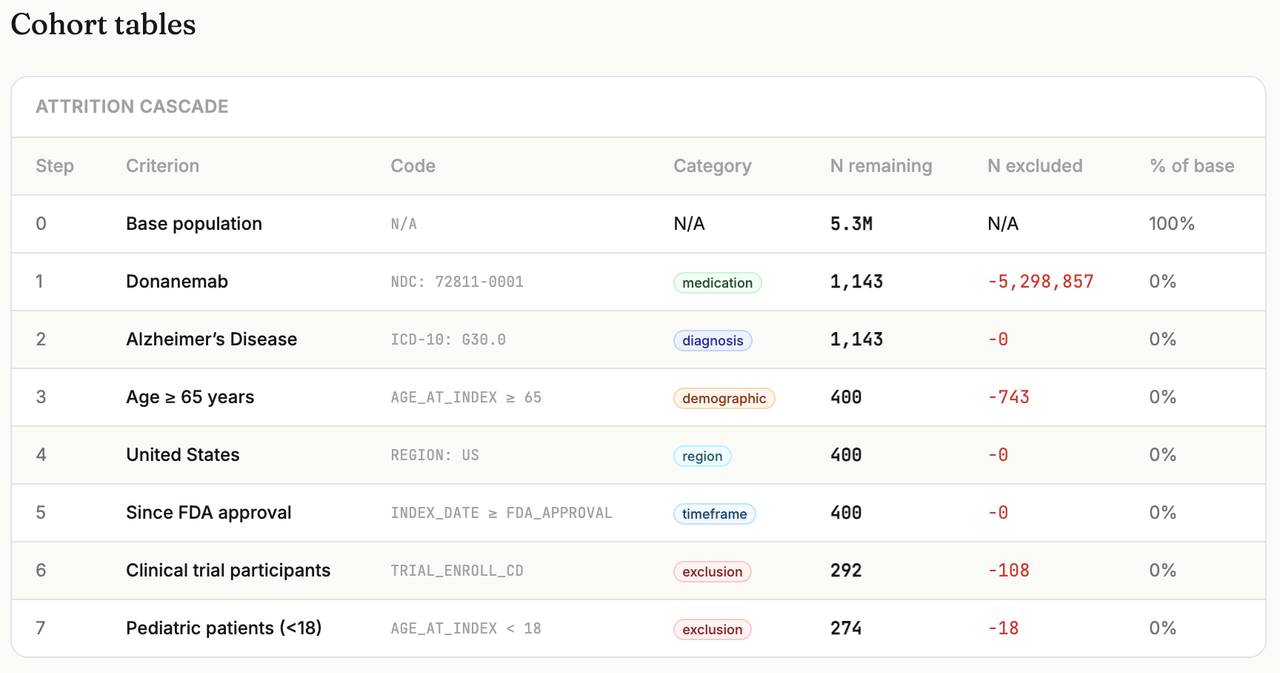
Fig. 2 — The attrition waterfall: every exclusion step, named and counted.
Benefits: What Changes for Each Team
-
Clinical research coordinators: eligibility screening is cognitively demanding, difficult to standardize,, and highly susceptible to variation. The Cohort Builder gives them a structured workflow where the criteria do the reasoning, not their memory faster screening, fewer missed patients, and a list they can hand a sponsor with confidence.
-
HEOR and medical affairs teams: feasibility answers that used to mean a data request and an analyst queue now run in minutes, against real linked claims and EHR data. The attrition waterfall shows immediately which criteria are doing the most exclusion work, often the fastest path to a protocol adjustment decision.
-
Sponsors and CROs: cross-site consistency and methodological defensibility. Every cohort built through the system is versioned criteria, codes, clarification answers, attrition steps, evidence citations. When a study gets challenged, the answer to "how did you identify these patients?" is a structured, exportable audit report, not a conversation with a site coordinator about what they remember doing.
What the Output Looks Like
Beyond the patient count, the system generates a complete cohort profile: age distribution, comorbidity burden, payer mix, treatment patterns, and simulated survival curves. In the Donanemab example, the 292-patient cohort showed a median age of 72, 53.4% female, 67% with hypertension, and 41% with depression baseline characterization that normally requires a separate analysis step.
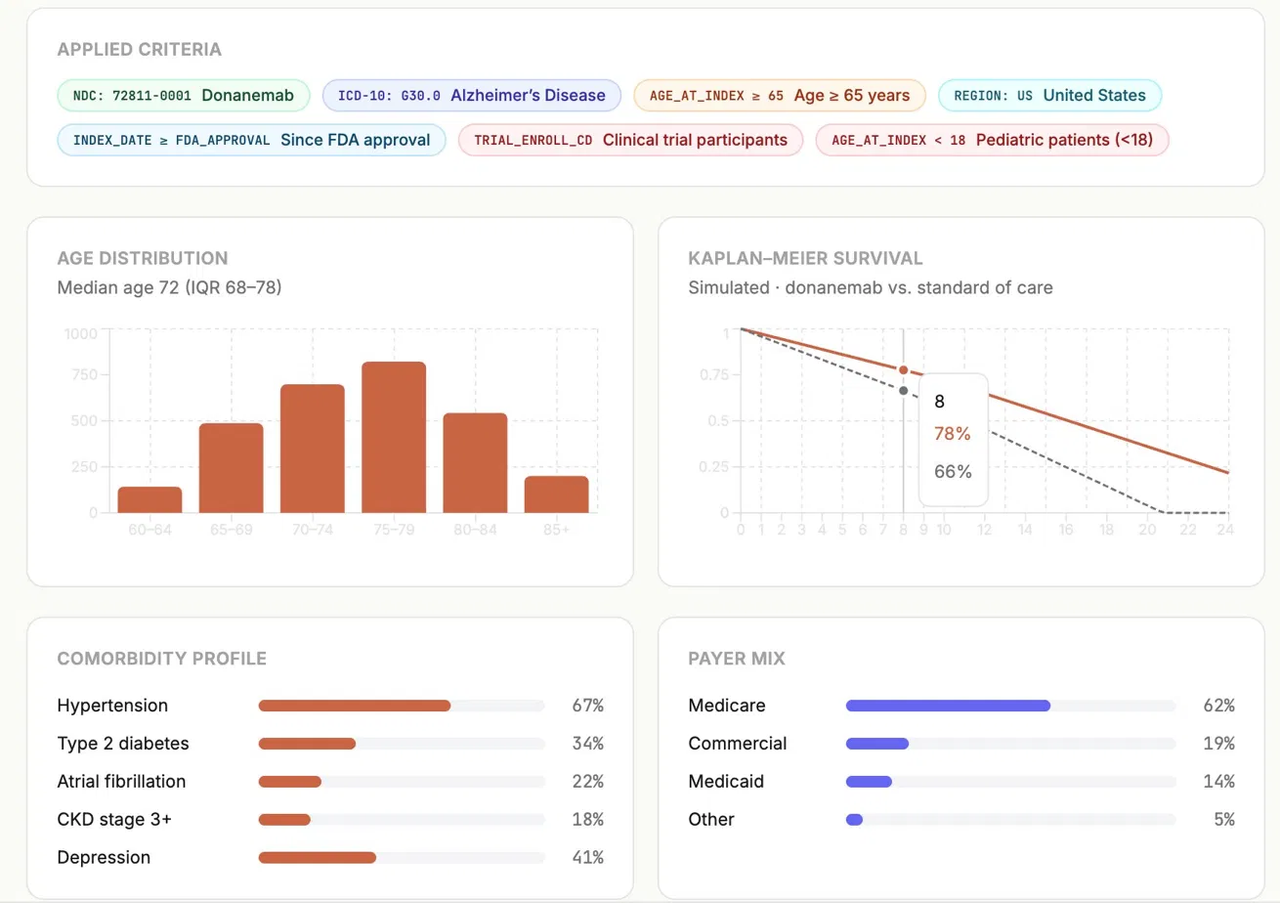
Fig. 3 — Cohort profile generated automatically alongside the patient count.
Conclusion
Real-world evidence has a reproducibility problem the field has largely accepted as inevitable. Studies get challenged not because the clinical logic was wrong, but because the cohort can't be reconstructed which code list, which data source, or how an ambiguous criterion was resolved.
The Cohort Builder makes those questions answerable by design not as a documentation exercise layered on top of the workflow, but as a natural output of a process structured from the first step. The system caches every concept expansion, every ICD code mapping, every drug synonym set, every radiology phrase, so each successive run builds on verified prior work, each cohort strengthening the foundation the next one inherits.
In a field where enrollment delays and cohort quality issues cost studies months and millions, infrastructure that improves clinical trial feasibility from the first query is infrastructure worth building.
To see how atomized cohort intelligence fits into a broader real-world evidence strategy, explore our website.
FAQs
What is clinical trial feasibility assessment?
It's the process of estimating how many eligible patients exist for a given protocol before a study is designed or launched, typically by applying inclusion/exclusion criteria against real patient data.
What does it mean to "atomize" inclusion/exclusion criteria?
Atomization breaks a compound eligibility criterion into its smallest individually checkable facts drug exposure, diagnosis, age, geography, timeframe so each one can be resolved against structured data on its own, rather than interpreted as a single block of text.
How is AI-driven cohort building different from a standard database query?
A standard query looks for exact matches. An AI-driven cohort tool classifies and expands each criterion into the correct clinical vocabulary (ICD, NDC, J-codes) first, resolves ambiguity through clarifying questions, and produces a step-by-step attrition waterfall that shows exactly why each patient was included or excluded.
Can this replace clinical research coordinators?
No, it's designed to support their workflow, not replace it. Coordinators still review and finalize cohorts; the tool removes the manual, chart-by-chart interpretation work that introduces inconsistency.
What is a clinical trial site feasibility patient database?
A structured repository of real patient data from EHRs, claims, and registries used to estimate how many eligible patients exist for a given protocol. It replaces manual, experience-based estimation with data-driven, criterion-by-criterion patient counts before a study launches.
What are clinical trial site feasibility assessment criteria?
The factors a sponsor or CRO evaluates to determine whether a site can successfully execute a trial. Key criteria include patient population size, inclusion/exclusion workability, site infrastructure, staff capacity, regulatory readiness, and historical enrollment performance with patient identification being the most critical and most carefully evaluated factor.
