
August 10, 2026
How Real World Data (RWD) Is Transforming Neurology Clinical Trials
"Neurodiscovery AI has been instrumental in transforming real-world neurology data into actionable insights that improve patient care and sustain private practice. Their commitment to neurologists—ensuring both business success and innovation in drug discovery—makes them an invaluable partner to NeuroNet and the entire field of community neurology."
Joseph V. Fritz PhDPartner,
Neurology has the narrowest margin for error of almost any therapeutic area when it comes to finding trial-eligible patients. Diagnoses are often delayed, disease presentation varies widely between patients, and many of the variables of a protocol depend on functional scores, biomarker status, and imaging findings were never designed to be searchable. Real world data is changing that equation, giving sponsors and CROs a way to see the eligible population as it actually exists, not as it's assumed to exist from published literature.
Real world data (RWD) health information collected outside a controlled trial setting, from electronic health records, claims, registries, and other routine-care sources has moved from a supporting role in commercialization to a central input in how neurology trials are designed, sited, and run. This piece looks at what real world data actually is, why it matters specifically for neurology, where it's hardest to use well, and how specialized data infrastructure is closing that gap.
What Is Real World Data?
Real world data is health-related information collected outside the structure of a clinical trial generated during routine patient care rather than a controlled research protocol. Common sources include electronic health records (EHR), medical claims and billing data, disease registries, and biomarker or imaging repositories.
It's worth separating two terms that get used interchangeably but aren't the same thing. Real world data is the raw material the records themselves. Real world evidence (RWE) is the clinical evidence derived from analyzing that data and a conclusion about safety, effectiveness, or disease patterns drawn from RWD using a defined methodology. RWD is the input; RWE is the output. A trial design team, a HEOR analyst, and a regulatory submission all consume real world evidence, but that evidence is only as good as the real world data it was built on.
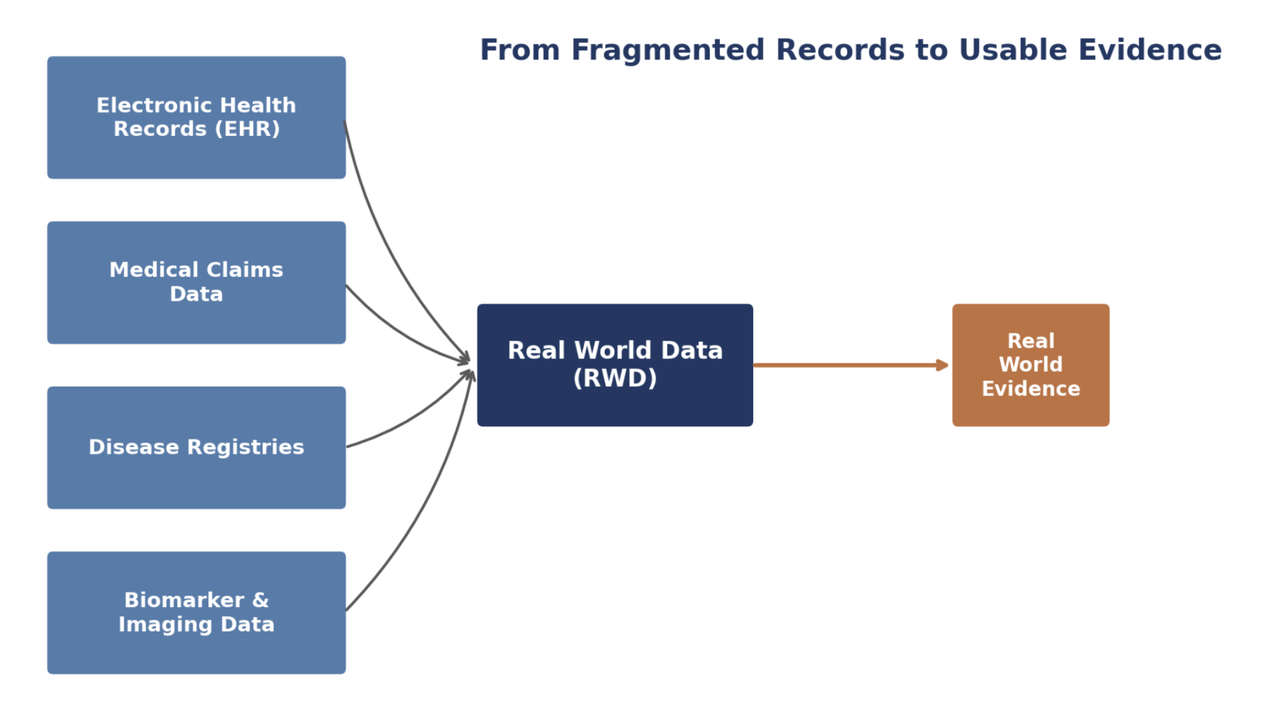 Fig. 1 — Real world data draws from multiple fragmented sources before it becomes usable evidence.
Why Real World Data Matters for Neurology Trials
Published natural history data for many neurology indications is thin, especially in rare and progressive disease. A trial team designing eligibility criteria for a handful of published cohort studies is working with a much smaller, often older and less representative, dataset than what actually exists in routine neurology care. Real world data closes that gap directly; it reflects the full range of patients being seen and treated today, including the ones who never make it into a published study.
It also changes what's possible operationally. A feasibility question that used to require a formal literature review or a slow, manual chart-abstraction project can instead be answered against real patient records how many patients in a given region meet a proposed inclusion criterion, what their comorbidity profile looks like, how a criterion change would move the eligible population up or down. That kind of real-time population insight is what allows real world data to inform a protocol while it's still being drafted, not just to explain results after a trial concludes.
Challenges in Using Real World Data for Trial Design
-
Fragmentation. EHR systems, claims databases, and disease registries rarely talk to each other, and a single patient's record is often split across several of them.
-
Unstructured documentation. The variables that matter most in neurology functional status, symptom severity, cognitive scores usually live in clinical notes rather than coded fields, requiring note-level extraction to become usable.
-
Data quality and completeness. Real world data reflects routine care, not a trial's assessment schedule, so key variables can be documented inconsistently or missing entirely for a meaningful share of patients.
-
De-identification and governance. Using real world data at scale requires rigorous privacy safeguards and clear data provenance, a requirement regulators and IRBs scrutinize closely.
How the Industry Uses Real World Data Today
Sponsors and CROs draw on real world data for a widening set of use cases: feasibility counts before a protocol is locked, external control arms in place of a randomized placebo group, post-approval safety surveillance, and health economics and outcomes research. The FDA's Real-World Evidence Framework has formalized how real world data can support regulatory decisions when the underlying data and methodology meet an appropriate evidentiary bar.
Most of that work still draws on administrative claims databases, which offer broad population coverage but limited clinical depth few functional scores, minimal note-level detail, and diagnosis coding that doesn't capture the nuance neurology protocols usually need. Disease registries offer more clinical depth but smaller sample sizes. The gap between the two is exactly where specialty real world data built for note-level clinical detail at population scale has the most to offer.
How NeuroDiscovery AI Turns Real World Data Into Usable Evidence
NeuroDiscovery AI extracts real world data directly from clinical documentation, not just coded fields across a base of 6M+ patient records and 3M+ active patients, spanning 1,000+ providers and 100+ clinical sites in 16+ U.S. states. That extraction is what turns a claims code into a clinically meaningful variable: a functional score buried in a progress note, an imaging finding described in radiology text, a treatment response documented in free text rather than a structured field.
For neurology specifically, that depth matters more than raw data volume. A feasibility question, an eligibility criterion stress-test, or a natural-history baseline is only as useful as the clinical detail behind it and that detail is exactly what gets lost when real world data is treated as a claims-coding exercise rather than a clinical-documentation one.
Benefits
-
Realistic eligibility criteria. Protocol teams can test inclusion/exclusion criteria against the real, current patient population before locking a design.
-
Faster feasibility answers. Population and site-feasibility questions get answered against real world data in days, not the weeks a manual chart-review cycle typically takes.
-
Stronger evidence generation. Real world data supports external control arms, natural history baselines, and HEOR models grounded in the actual treated population.
-
Broader, more representative populations. Real world data captures patients seen in community and non-academic settings, not just those enrolled in prior published research.
-
Regulatory-aligned pathway. The FDA's real world evidence framework provides a defined route for real world data to support regulatory and access decisions when methodology is sound.
Conclusion
Real world data is most valuable in neurology trials when it's read at the level of clinical detail the disease actually requires not just structured codes, but the notes, scores, and findings that describe how a patient's condition really presents. Trial teams that can access that detail early get a genuine advantage: eligibility criteria tested against reality, feasibility questions answered in days, and an evidence base that reflects the patients a therapy will actually serve.
To see how real world data can inform your next protocol, explore.
FAQs
-
What is real world data?
Real world data (RWD) is health-related information collected outside a clinical trial, from sources like electronic health records, medical claims, disease registries, and biomarker or imaging data, generated during routine patient care.
-
What's the difference between real world data and real world evidence?
Real world data is the raw information itself; real world evidence is the clinical evidence about safety, effectiveness, or disease patterns derived from analyzing that data using a defined methodology.
-
How is real world data used in clinical trials?
Real world data supports feasibility assessment, eligibility-criteria testing, external control arms, natural history characterization, post-approval safety monitoring, and health economics and outcomes research.
-
Why is real world data especially important in neurology?
Neurology diagnoses are often delayed, disease presentation is highly variable, and key variables like functional and cognitive scores are usually documented in clinical notes rather than structured fields making note-level real world data extraction especially valuable.
-
Is real world data accepted by regulators?
Yes, under appropriate methodological conditions. The FDA's Real-World Evidence Framework and subsequent guidance define how real world data and the evidence derived from it can support regulatory decisions.
